Algorithmic worlds
Portfolio |
- |
Information |
- |
Blog |
- |
Prints |
- |
Links |
About algorithmic worlds
IntroductionAlgorithmic art
Pictorial algorithms
Ultra Fractal
Algorithmic worlds
Piling patterns
The structure
Pattern generators
Index operators
The piling operator
An example
Other modules
The structure of the algorithm
The pictorial algorithms used to produce the works displayed here decompose into basic modules, ie. smaller algorithms. These are essentially of three
types, as summarized in the table below: the pattern generators, the
index operators, and a single module of the last type, the piling operator.
| Module | Input | Output | Aim |
|---|---|---|---|
| Pattern generator | Pixel coordinates | Index | Creates a pattern |
| Index operator | Index | Index | Modifies a pattern |
| Piling operator | Pattern | Index | Piles scaled copies of a pattern |
The pattern generators draw simple patterns. Practically, they read the coordinates of the pixel currently computed and use them to produce a value of the index (see the section Ultra Fractal).
The index operators are used to modify the visual aspect of the patterns. To this end, they transform the index produced by a pattern generator. They accept one or several values of the index as an input and perform some mathematical operations on it before they return it. They may also use the coordinates of the pixel to carry out their computations.
As a result, the general structure of the algorithms built out of the
first two types of modules is a tree graph, like the one depicted in the white box in the diagram below. The arrows represent a value of the index
transferred from one module to another. The leaves correspond to pattern
generators (in green) while the nodes are index operators (in blue). The tree has a single root, so the corresponding algorithm is a pictorial algorithm: it returns a single value of the index given a value of the pixel coordinates, hence produces a pattern. A concrete example will be provided later.
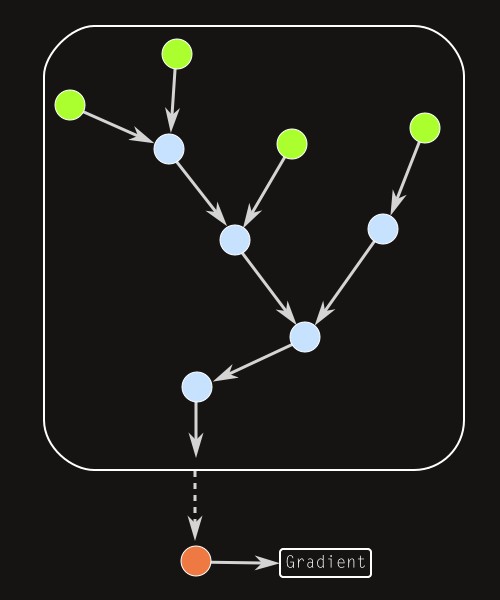
As we mentionned, to produce an algorithmic world, we want to pile
copies of a given pattern at various scales. This is the work performed
by the piling operator (in red in the diagramm above). It accepts as
input a whole tree of modules, uses it to create multiple scaled copies
of the corresponding pattern and merges them to return the final value
of the index. The latter is then transformed into a color through the
gradient.
| Copyright S.Monnier 2009-2026. | . |